
Executive Summary
It’s easy to dismiss the skyrocketing valuations of AI startups as hype-fueled and FOMO-driven—especially when they appear disconnected from traditional investment logic. But writing them off as a “dot-com event” risks missing a critical signal.
Beneath the noise, something deeper is unfolding: AI is beginning to reshape how people expect to engage with products and brands.
Customers are no longer just looking for emotionally crafted messaging—they’re starting to expect emotionally responsive interactions. This goes beyond the idea of “emotional jobs to be done.” AI can now simulate empathy, interpret mood, adapt tone, and respond in emotionally intelligent ways. It’s not about marketing emotion—it’s about embedding it directly into the interaction layer. The new user expectation: “Don’t just know what I want. Understand how I feel—in real time.”
Whether you’re a startup or an established brand, this shift in customer engagement must be intentionally designed into your emotional technology stack. In this new era, utility is the entry fee, emotional connection is the expectation, and meaning is the multiplier.
For fun, I developed an AI Meaning-Market Resonance Model (versus Product Market Fit) to assess brands across product utility, emotional connectivity and meaning/resonance. I’m surprised by the insight and nuances – and the opportunity the model identified. If you interested in a free run through for your brand, get in touch!
AI Valuations – Noise, Hype, or Signal
With OpenAI/ChatGPT ($300B), Lovable (est. $50M), Windsurf ($3B), and Perplexity ($14B) reaching stratospheric valuations within just two years of launching, many are left wondering: How and why, and what am I missing?
In short, tech pre-AI was driven primarily by product-market fit—i.e., product utility, scalability, and UX (growth design). Human interaction was influenced primarily by behavioral algorithms, and people have learned how to use and interact with such tech.
However, AI-enabled tech is promising an opportunity to go beyond product utility and growth design and build empathetic and emotional connections with users.
A simple example of such a shift is the increasing number of users switching from Google to ChatGPT as a “search engine that understands what I’m asking.” Although the potential investor returns of being the next Amazon, Google, or Apple in this new AI era are understandably huge, the truth is that investors don’t know how to value these AI startups—with many investing due to FOMO without understanding or testing any real strategic fundamentals.
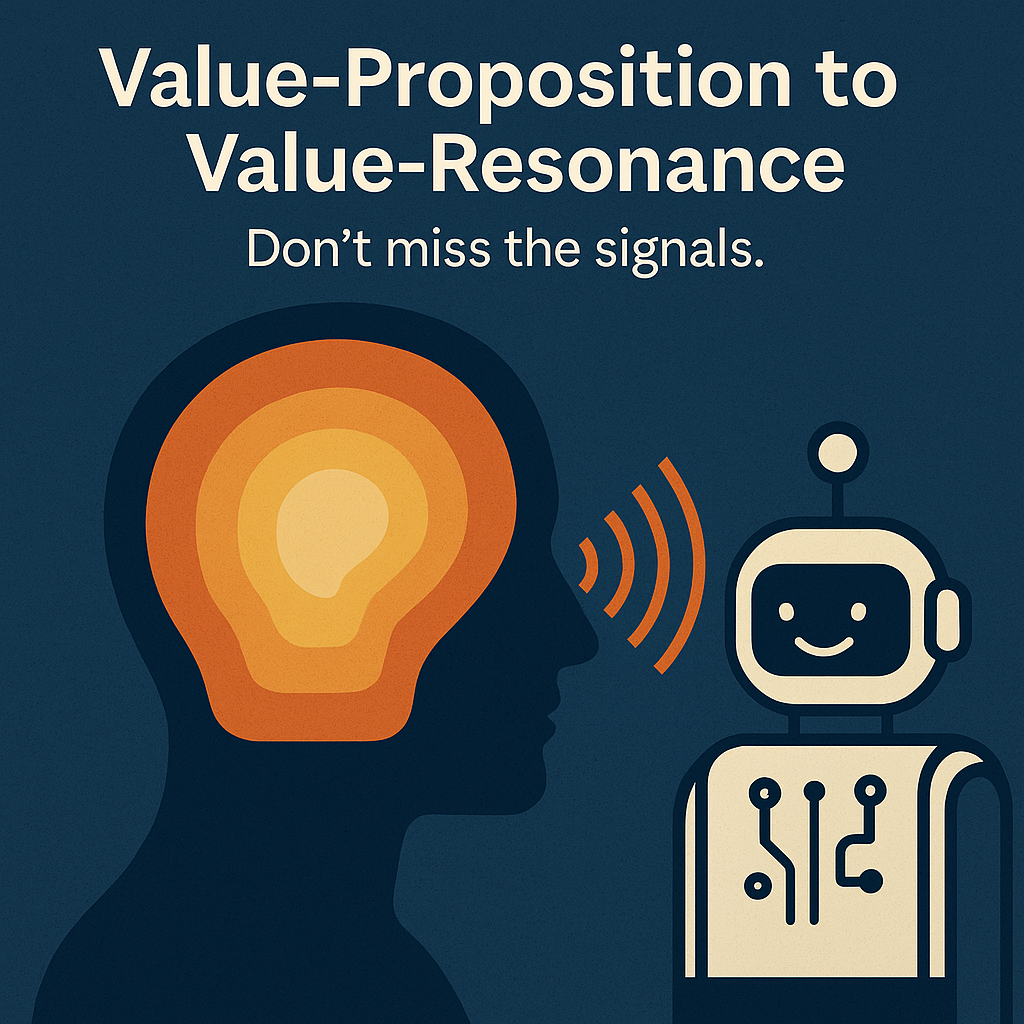
The Signal: From Value-Proposition to Value-Resonance
Although there are still many questions and uncertainties around the “stickiness and traction” of AI’s ability to mimic empathy and emotional intelligence, people’s engagement with AI is already beginning to shape a shift from value proposition to value resonance—not just changing what consumers expect but also how they experience and emotionally interpret brands.
AI personalizes at an emotional scale: It tailors content, tone, and experiences in real time, making interactions feel uniquely personal. This level of emotional relevance sets a new standard for user connection and engagement.
It simulates empathy and attention: AI tools can read sentiment, context, and intent—creating the impression of being emotionally understood. Users start to expect brands to listen, respond, and adapt like a human would.
It shifts engagement from transactional to relational: Interactions with AI feel conversational, not just functional. Users don’t just want answers—they want brands that “get them.”
It raises the bar for brand relevance: Static messaging now feels cold; AI-trained users expect adaptive, emotionally intelligent responses. Brands must shift from broadcasting messages to mirroring mindsets and moods.
It helps non-tech brands humanize at scale: AI enables traditional businesses to deliver personalized, emotionally aware experiences cheaply. Human-like connection is no longer a luxury—it’s scalable and becoming expected.
The New Playbook: Building for Resonance, Not Just Rea
If you’re building anything today—a product, a brand, an investment thesis—here’s what to start doing:
Emotion is Table Stakes. Identity is the Multiplier: Affinity is good. Alignment is great. Meaning creates narrative velocity—your brand story becomes theirs.
Data Isn’t Just for Optimization: It’s for insight into aspiration, avoidance, and longing. Use it to shape tone, values, and product.
Start with Culture, Not Just Trends: Spend time in your audience’s online spaces. Map the memes, jokes, subcultures, and value signals. That’s your brand intelligence.
Design for Resonance: Build experiences that are emotionally intelligent, culturally fluent, and symbolically rich. Think less about funnel metrics and more about identity moments—when your product reflects who someone is or who they want to be.
The bottom line: AI elevates your ability to become a “meaning company.” Because in this new era, utility is the entry fee. Meaning is the multiplier. That’s not just the future of tech—it’s the future of strategy.