
Why a COGS Playbook Matters
When you run a business, money flows in and out every single day. Customers pay you for your product or service, and you, in turn, pay for the things it takes to deliver on that promise. Somewhere in the middle is a number that can make or break your business: the Cost of Goods Sold (COGS).
COGS is not just an accounting term—it’s the real cost of doing business. It answers the simple but powerful question:
👉 How much does it really cost me to create or deliver what I sell?
For product-based businesses, that means the cost of materials, packaging, and the wages of the people who assemble or prepare the product. For service-based businesses, it might include wages of staff delivering the service, software subscriptions tied directly to delivery, or subcontractor fees.
Why Entrepreneurs Struggle with COGS
Many entrepreneurs—especially those just starting out—confuse sales with profit. You see money coming in, and it feels like you’re doing well. But unless you’ve accounted for the costs that go into making those sales, you may be running a business that looks busy but is quietly bleeding cash.
Here are common traps:
- Setting prices without knowing true costs, leading to razor-thin or negative margins.
- Treating all expenses the same, without separating direct costs (COGS) from operating costs (rent, marketing, admin).
- Failing to track inventory properly, leading to surprises when tax season arrives or cash runs short.
Why This Playbook Exists
This playbook is designed to give you:
- Clarity on what COGS is (and isn’t).
- Confidence in calculating your true costs, whether you run a coffee shop, a landscaping company, or a digital startup.
- Control over your pricing, margins, and cash flow so you can make smarter decisions and grow a healthy, sustainable business.
We’ll walk through simple explanations, practical examples, and industry-specific case studies. You’ll also find templates and checklists you can put into action immediately—no accounting degree required.
How to Use This Playbook
Think of this as your field guide:
- If you’re new, start at the beginning to build a solid foundation.
- If you’ve been in business for years but struggle with numbers, skip to the case studies or templates to apply directly to your situation.
- If you’re scaling, focus on the later sections where we discuss advanced tracking and cost control.
By the end, you’ll know how to answer the question every successful entrepreneur can:
👉 Am I really making money on what I sell?
That’s the power of understanding COGS. And once you have that power, you’ll never look at your business the same way again.
Foundations of COGS
At its core, Cost of Goods Sold (COGS) is the amount of money it costs you to make or deliver your product or service. It’s the direct costs only — the things you can point to and say: “Without this, I couldn’t sell what I sell”. In other words, when we speak of COGS or direct costs (they are the same thing), we mean the expenses that can be clearly and directly tied to making your product or delivering your service. These are the items that rise and fall depending on how much you sell. If you sell more, your direct costs go up. If you sell less, they go down.
- If you sell products, COGS includes raw materials, packaging, and labor directly tied to making the product.
- If you sell services, COGS could be subcontractor fees, staff wages for delivering the service, or even software that’s essential to providing the service.
Think of COGS as that makes your sales possible. Without it, nothing moves.
Why COGS Matters for Entrepreneurs
Here’s why COGS is so important:
- It shapes your pricing.
Your price isn’t just about what the market will bear; it has to reflect the real cost of producing or delivering your offering.
If you don’t know your COGS, you risk pricing too low — every sale becomes a hidden loss. However, if you know your COGS, you can confidently set a price that covers costs and leaves room for profit.
This also helps when negotiating discounts. You’ll know your minimum acceptable price without guesswork.
Example: If it costs you $12 to produce a product and you sell it for $15, you’re only earning $3 per unit before covering rent, marketing, and other expenses. If you didn’t know your true COGS, you might mistakenly think $15 was “good enough.”
- It reveals your profit margins.
COGS is the key to understanding gross profit, which is Sales minus COGS.
Gross profit tells you how much money is left after paying for the product or service itself, but before paying for overhead.
This figure is critical for measuring efficiency and sustainability.
By comparing gross profit across different products or services, you can see which ones are worth pushing and which ones may need to be rethought.
Example: A bakery might discover that muffins deliver a 60% gross margin while cakes only deliver 30%. Knowing this, they can decide where to focus their marketing energy.
- It keeps you honest.
Entrepreneurs often focus on top-line sales because sales feel like success. But sales without profit are a trap.
COGS forces you to face reality: you can be busy, even popular, and still be losing money.
By regularly reviewing COGS, you avoid “vanity metrics” (sales volume) and focus on health metrics (profitability).
Investors, lenders, and partners also look closely at gross margin (sales minus COGS). If you can’t explain it, they’ll worry about your financial management.
Example: A catering company might win a $100,000 contract. On paper, it looks impressive. But if the food, labor, and supplies (COGS) eat up $85,000, that leaves only $15,000 before rent, insurance, and wages. The “big win” may actually strain cash flow instead of boosting it.
✅ Bottom Line
COGS isn’t just an accounting detail — it’s the lens through which you can see if your business model works.
- Without it, you’re flying blind, risking underpricing and overstretching.
- With it, you can price confidently, prioritize the right offerings, and prove to yourself (and others) that your business is truly profitable.
COGS in the Income Statement (Profit-Loss Statement)
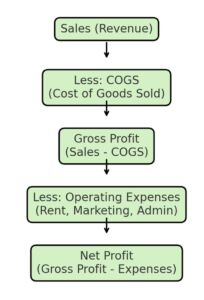
If you look at a properly constructed income statement, COGS sits right below sales:
Sales (Revenue)
– Cost of Goods Sold (COGS)
= Gross Profit
Then, from Gross Profit, you subtract operating expenses (rent, salaries, marketing, etc.) to arrive at Net Profit.
This structure shows you exactly how much money each sale contributes to the bottom line once the direct costs are stripped out.
COGS vs. Operating Expenses
A common mistake is mixing up COGS with Operating Expenses. Here’s the difference:
• COGS: Direct costs tied to making or delivering your product/service.
Example: Coffee beans, milk, cups, barista wages.
• Operating Expenses: The overhead of running your business.
Example: Rent, Wi-Fi bill, social media ads, accountant fees.
👉 If you confuse the two, your financials get blurry, and you may think your margins are stronger (or weaker) than they really are.
✅ Takeaway:
COGS is the foundation of profitability. Get it right, and you can build pricing, cash flow, and growth strategies that actually make sense. Get it wrong, and you risk building a business that looks busy but isn’t truly sustainable.