
Feedback Loops: Turning Critique Into Capability
At CEED, we see a pattern that cuts across both new founders and established businesses. The entrepreneurs who improve fastest aren’t the ones who never get criticized. They’re the ones who can take critique—customer pushback, team frustration, a mentor’s blunt observation—and turn it into a practical improvement cycle. In other words, they run feedback loops.
A feedback loop is simple: you try something, you watch what happens, you think about what it means, you make a change, and you try again. The mistake is treating feedback like a judgment on you as a person or a leader. When feedback hits your identity—“I’m not good at this,” “they don’t respect me,” “we’re failing”—most people react by protecting themselves. You get defensive, you explain it away, or you avoid the topic. That reaction is normal, but it slows down the one thing that builds real skill: learning through repeated cycles.
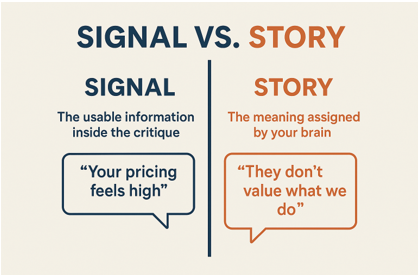
The key move is to separate the signal from the story. The signal is the useful information inside the feedback. The story is the meaning your brain adds to make the moment feel safer or clearer. “Your pricing feels high” is a signal. “They don’t value what we do” is a story. “This proposal is hard to follow” is a signal. “Our team is incompetent” is a story. Stories feel good because they give quick answers. Signals are harder because they force you to change something. But signals are where progress comes from.
Once you start looking for the signal instead of getting pulled into the story, you’ll notice that feedback shows up in very practical ways at every stage of business.
For new founders, feedback often shows up as silence or hesitation. People don’t reply. Calls go quiet. Prospects say “interesting” and then disappear. For existing businesses, feedback often shows up as churn, tighter margins, late projects, a stressed team, or the same customer complaints over and over. Different stage, same idea: you don’t need more opinions—you need a clear way to pull out the signal and turn it into action.
Not all feedback should be treated the same. Strong feedback usually has a few signs.
· It comes from people who really know what happened (real customers, real users, team members doing the work).
· It is specific enough to test (“I don’t understand your offer until the third paragraph”).
· You hear it more than once.
· And it shows up near a real decision—buying, renewing, hiring, paying, or referring.
Weak feedback is vague, dramatic, or coming from someone who isn’t your customer. If you treat every comment as equally important, you will bounce around and waste time.
After you pick out the signal, the next step is where many entrepreneurs get stuck: turning feedback into a test. Some people collect comments like receipts—lots of notes, but nothing changes. You build capability when you turn feedback into a small experiment: “If we change X, then Y should improve, and we’ll measure it with Z.” That takes feedback from something emotional and turns it into work you can do.
For a new founder, that might mean sharpening the first 20 seconds of a pitch, improving onboarding, or changing how you explain the problem you solve. For an existing business, it might mean revisiting pricing, reducing variation in how work is delivered, fixing handoffs, or setting clearer expectations with customers. The goal is not to “take feedback.” The goal is to close the loop: make a change, see what happens, keep what works, and repeat.
This matters inside your team too. In small companies, people sometimes hold back feedback because they don’t want conflict or they don’t want to drain the founder’s energy. Over time, that creates a quiet drop in standards. Problems are felt but not said out loud, and “good enough” becomes normal. A healthy culture isn’t constant criticism. It’s clear expectations, quick course-correction, and a shared belief that feedback is about results, not personal attacks. When the leader models that, people stop walking on eggshells and start improving the system.
If you want a simple definition of maturity—whether you’re a first-time founder or running a company with staff—it’s this: you can hear critique without falling into shame, and you can hear praise without lowering your standards. You treat feedback as information, not as a label about who you are. You find the signal, run a test, and close the loop. Over time, you don’t just improve the business—you improve your ability to improve. That’s how progress compounds.
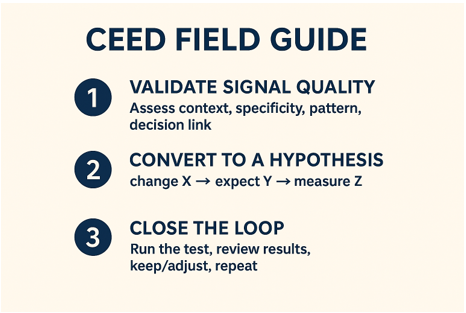
CEED Mindset Gym (10 minutes): Convert critique into a usable test
Set a timer. Choose one piece of critique you’ve received recently—customer feedback, team input, a partner’s objection, a recurring complaint. Then run this micro-loop.
Minute 1–2: Write the critique verbatim.
Capture the exact words, without cleaning them up.
Minute 3–4: Separate signal from story.
Write two lines:
Signal (testable): ________
Story (interpretation): ________
Minute 5–6: Rate feedback quality (quick filter).
Answer in one sentence each:
Context: Do they have direct experience?
Specificity: Can I test this within 7–14 days?
Pattern: Have I heard this before?
Decision link: Did this show up near a real decision moment?
Minute 7–8: Turn it into a hypothesis.
Use this format:
“If we change ________, then ________ will improve, measured by ________.”
Minute 9–10: Pre-commit the next action.
Write it in calendar language:
“On [day], at [time], I will [action] for [duration] to test this hypothesis.”
Example 1 (new founder): “I don’t really get what you do.”
Signal: the value proposition is unclear early in the pitch.
Hypothesis: “If we lead with the customer outcome in the first sentence and remove jargon, then comprehension will improve, measured by fewer ‘what is it?’ questions and more ‘send me details’ follow-ups.”
Pre-commit: “On Tuesday at 9:00 a.m., I will rewrite the first 20 seconds of the pitch and test it in two prospect calls this week.”
Example 2 (existing business): “Your projects are good, but they’re slow.”
Signal: delivery cycle time is a pain point, not quality.
Hypothesis: “If we add a weekly client update plus an internal milestone cadence, then perceived speed and trust will improve, measured by fewer escalation emails and faster approvals.”
Pre-commit: “On Thursday at 3:00 p.m., I will set up a weekly update template and run it with two active clients for two weeks.”
At CEED, we don’t treat feedback as a personality test—we treat it as performance data. Whether you’re a new founder trying to earn your first “yes,” or an established business working to tighten delivery, reduce churn, or protect margin, the advantage goes to the entrepreneurs who can run clean learning cycles. Separate signal from story, turn critique into a test, and close the loop with evidence. Do that consistently and you’ll notice something important: the business gets stronger, but so do you. You become less reactive, more rigorous, and more confident—not because you avoid criticism, but because you’ve built a reliable way to convert it into capability.
What’s Next In The Series
In the next blog, we’ll look at a surprisingly practical lever for entrepreneurial performance: the language you use with yourself when things get messy. Under pressure, founders don’t just make decisions—they narrate what those decisions mean (“I blew it,” “this is a dead end,” “I’m behind”). That self-talk quietly drives risk tolerance, persistence, and how quickly you recover from setbacks. We’ll unpack the patterns that high-learning entrepreneurs use differently, show how to spot unhelpful scripts in real time, and offer a simple 10-minute Mindset Gym practice to replace judgment with better questions—so you can learn faster without needing perfect conditions.