
Two fundamentally different search experiences are competing for dominance, and the winner will determine which brands thrive in the next decade. While most companies continue optimizing for Google’s traditional search model, millions of users are increasingly shifting to LLM-powered search that works in completely different ways.
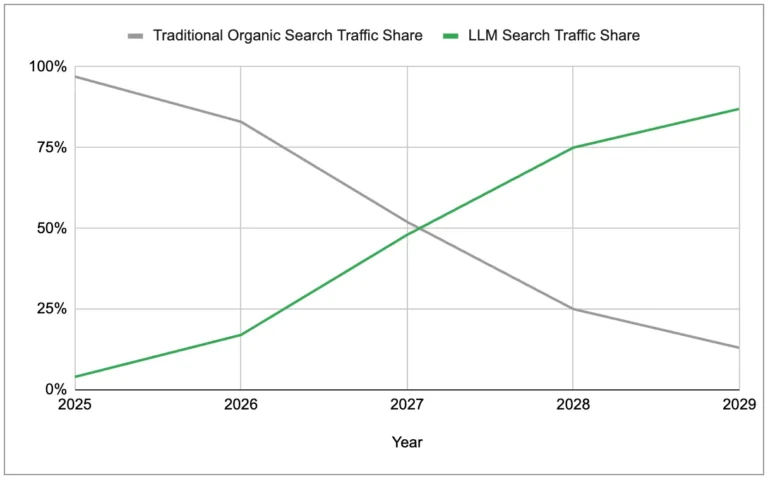
Semrush Study 2025
Google helps you find information. LLMs give you answers.
Google Search Model: User enters keywords → Google returns ranked list of web pages → User clicks through multiple results → Compares information across sites → Makes decision
LLM Search Model: User asks natural language question → AI synthesizes information from multiple sources → Provides direct, conversational answer → User may or may not seek additional sources
The difference is profound. Google helps you find information. LLMs give you answers.
What This Means for Brand Discovery
In Google’s world, being discoverable meant ranking high for relevant keywords. In the LLM world, being discoverable means being part of the AI’s knowledge base and reasoning process. “If the AI mentions your name directly, that’s the new gold.”
Consider what happens when someone searches for a business solution.
Google Search: “best project management software small business”
Returns list of comparison sites, vendor pages, review platforms
Brand visibility depends on search ranking and ad placement
LLM Search: “What’s the best project management tool for a 10-person marketing team?”
Returns synthesized recommendation with specific reasoning
Brand visibility depends on being part of AI’s training data and reasoning
Why Traditional SEO Strategies Fall Short
Google search optimization focused on keyword density, technical performance, and backlinks.
LLM search evaluation considers:
Depth of available information across multiple sources
Narrative consistency in how the brand is described
Contextual relevance to specific use cases and problems
Authority signals from diverse, credible sources
Traditional SEO tactics can’t address these new ranking factors. They require a fundamentally different approach.
The Media Strategy LLMs Demand
To succeed in LLM search, brands need comprehensive media strategies:
Educational Content Libraries: Develop extensive resources that establish domain expertise. When LLMs analyze your industry, substantial educational content increases mention probability.
Detailed Use Case Documentation: Create comprehensive scenarios showing how your solution addresses specific problems. LLMs rely heavily on concrete examples when making recommendations.
Multi-Source Presence: Ensure consistent brand information appears across platforms and publications. LLMs synthesize from diverse sources, so single-channel strategies fail.
Thought Leadership Publishing: Regular industry commentary helps LLMs understand your brand’s positioning and expertise areas.
The Strategic Questions Every Brand Should Ask
“When an LLM analyzes our industry, is there enough quality information about our brand to warrant inclusion in recommendations?”
“Are we creating content that helps AI systems understand not just what we do, but why we’re uniquely valuable for specific use cases?”
The Timeline Reality
This transition isn’t theoretical. ChatGPT, Claude, Perplexity, and other LLM tools are already handling millions of search queries daily. Google is integrating AI-generated answers into search results. The shift is accelerating, not approaching.
The move from Google search to LLM search represents the biggest discovery disruption since Google displaced Yellow Pages. But this window won’t stay open indefinitely. As more brands recognize the shift and begin building comprehensive media strategies, the competitive advantage of early adoption will diminish.
The question isn’t whether LLM search will change brand discovery—it’s whether your brand will be part of the new conversation when it does.
The brands that build their LLM search presence now will own tomorrow’s discovery landscape. The rest will wonder where their customers went.